

Laser-based reballing of ball grid array (BGA) components
Using a laser process to reball ball grid arrays (BGAs) is a particularly gentle technique. The targeted use of short laser pulses ensures that the component is not exposed to excessive thermal stress, exceeding the IPC guidelines by a significant margin.
Unlike conventional rework methods, the laser process complies with the manufacturer's specified limit of three reflow cycles at most. This makes it particularly suitable for sensitive components or those that have already undergone several processing cycles.

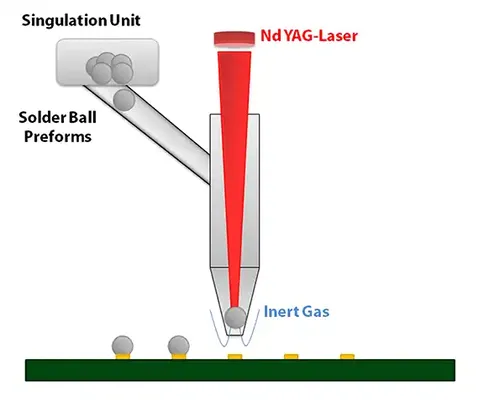
The reballing procedure is carried out using a specialised system designed for manufacturing BGA contacts. The BGA is positioned on a precisely controllable XY table. This table then moves automatically to the individual contact surfaces (pads).
At each position, a precisely sized solder bead (preform) is melted and applied under a nitrogen atmosphere using a short, high-energy laser pulse. The pad and ball are heated locally for a few milliseconds while the component itself remains at room temperature throughout the process.
Once ball application is complete, an optical inspection is performed to verify the planar alignment of all contacts (coplanarity). This is followed by a tempering process, after which the components are packaged in vacuum-sealed containers.
Laser technology also allows for a variety of application-specific adjustments:
- The combination of different ball diameters reduces mechanical stress caused by BGA warping
- Use of high-melting alloys to prevent the component from sinking during the subsequent reflow process
- Switching from leaded to lead-free balls to ensure RoHS compliance
- Switching back from lead-free to leaded materials, for example to meet military specifications when original components are unavailable
- Development and assembly of individual interposer solutions